
Support for Junior Fellows Across Disciplinary Boundaries
The Gutenberg Academy Fellows Program (GAFP) at the Johannes Gutenberg University Mainz (JGU) welcomed eleven new Junior Fellows during its annual induction ceremony. Junior Fellows are outstanding doctoral students and artists from all departments at JGU who, through the GAFP, can engage in interdisciplinary dialogue with like-minded peers and established scholars.
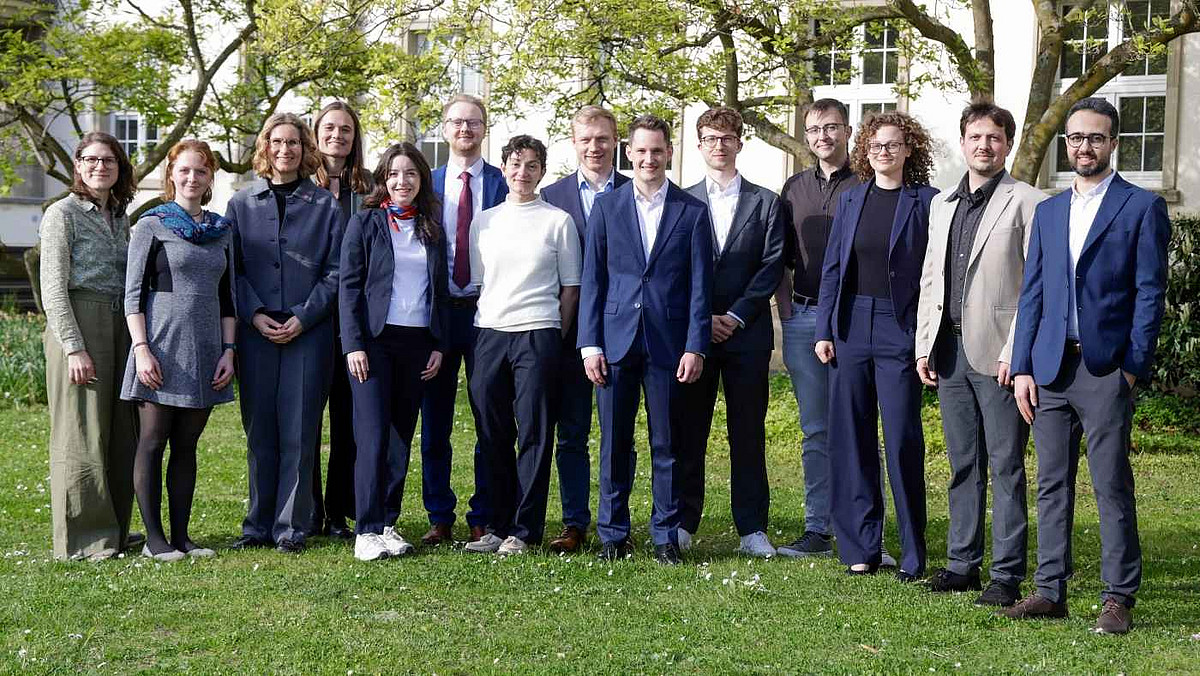
The new 2026 junior members of the Gutenberg Academy Fellows Program. Pictured (from left): Marie Schlosser (deputy junior spokesperson for the GAFP), Franziska Zmatlik (junior spokesperson for the GAFP), and Prof. Dr. Stefanie Acquavella-Rauch (senior spokesperson for the GAFP). Third from the right: Katharina Hermainski from the Superheavies group.
Photo/©: Stefan F. Sämmer
The GAFP offers Junior Fellows a stimulating intellectual environment for their further development, including opportunities for interdisciplinary exchange and networking. In addition to financial support for their doctoral projects and a mentorship with a Senior Fellow of the program, a central aspect of the support is a mentoring program featuring renowned figures from the fields of science, art, culture, politics, business, and society. GAFP Senior Fellows are distinguished scholars and artists at JGU.
In addition, Junior Fellows benefit from the program’s financial support, for example when attending conferences or visiting renowned laboratories. The GAFP serves as a valuable forum for presenting and discussing their own ideas and projects.
About 650 students earn their doctorates at JGU each year
Each year, about 650 students earn their doctorates at Johannes Gutenberg University Mainz (JGU). The university views the support of early-career researchers as a central mission and has launched a comprehensive program in recent years to provide targeted support to its doctoral students. Through the GAFP, JGU has been pursuing an interdisciplinary support concept for 20 years, which is aimed at up to 25 selected doctoral candidates and artists each year
Specifically, the eleven new Junior Fellows are doctoral candidates Clarissa Krämer (Business Informatics), Joshua Kriesmann (Law), Erik Sarrazin (Behavioral Economics), Helena Dieterle (Medicine), Ahmed Hassan (Medicine), Freya März (German Studies), David Eibeck (History), Lukas Drago Cavar (Physics), Hans Brabec (Toxicology), Katharina Hermainski (Chemistry) und Henrik Schuld (Musik).
They are supported by Senior Fellows - experienced researchers from the university - as well as mentors who are prominent public figures. Since the GAFP was founded in 2006, more than 200 early-career researchers and artists have received support.
The selection of new Junior Fellows takes place through a two-stage process. First, advisors submit a nomination report that comprehensively describes the candidate’s academic or artistic work. This is followed by a selection interview conducted by the GAFP. Finally, the active Fellows of the GAFP decide on the admission of the proposed candidates
In addition to welcoming the new Fellows, the GAFP also officially bid farewell to those Fellows whose membership has since ended during the ceremony. They now join the GAFP’s alumni community.
Source: This text is a translation of a JGU press release dated April 21, 2026
"Press release" (in German) dated April 21, 2026
Contact:
Elena Joser
Executive Director
Gutenberg Academy Fellows Program (GAFP)
Johannes Gutenberg University Mainz
55099 Mainz
Tel.: 06131 39-27205